
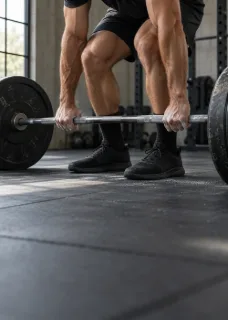
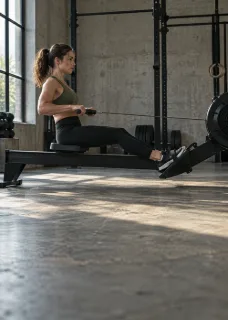
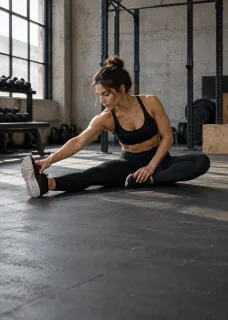
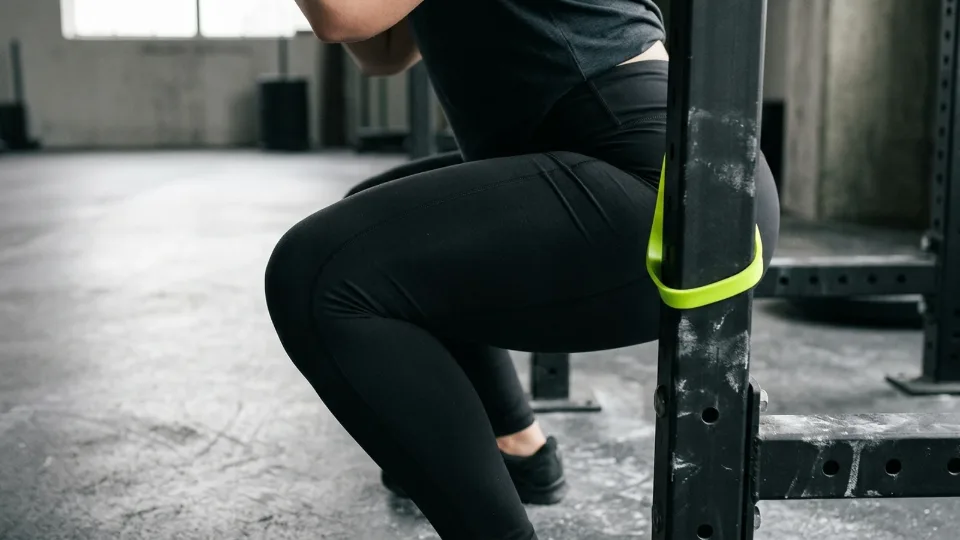
Stand side-on to a mirror in daylight, or under the brightest light in the room, and squat as deep as you would with a barbell. Look at the back of the thighs and the seat. If you can see skin tone or the outline of your underwear, the fabric is too thin or the size is too small, and it will only get worse after twenty washes. That is the squat test, and it rules out more leggings than any product description.
Try it at home with the tags still on. Our 30-day returns cover exactly this, so there is no reason to keep a pair that fails.
Nylon-spandex or seamless knit
Nylon-spandex
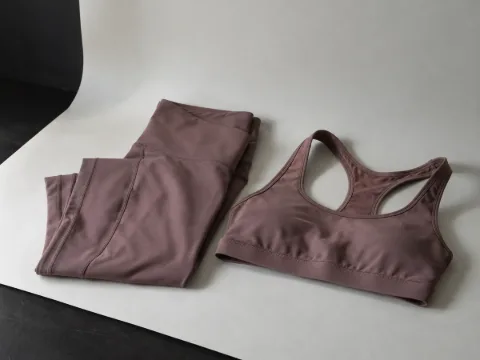
Most training leggings are a flat knit of nylon with roughly 20 to 30% spandex, cut into panels and sewn together. Nylon is smooth, strong and dries quickly, and the higher spandex content gives that firm, held-in feel. Because the fabric is cut from a sheet, there can be a gusset in the crotch and seams placed where they help the fit. Our High-Waist Leggings ($64) are made this way, with a compression fit. The trade-off is that seams can rub on long runs, and a cheap flat knit goes shiny and see-through where it stretches most.
Seamless knit
Seamless leggings are knitted as a tube on a circular machine, with ribbing and texture built into the knit instead of sewn-in panels. They feel softer, there are fewer seams to chafe, and the textured zones hide a lot. The downside is less structure: the fit depends on your shape matching the knit pattern, and fine seamless knits can thin at the knee and seat over time. The Seamless Leggings ($59) come in black, sky and sand. The paler two show sweat more, which some people mind and others do not.
What gsm tells you
Gsm means grams per square metre, the weight of the fabric. It is the closest thing to a squat-test number you will find on a label, when a brand lists it at all.
- Under about 200 gsm: light and cool, fine for hot studios and running, more likely to fail the squat test in pale colours.
- 220 to 280 gsm: the usual range for gym leggings. Opaque in most colours and still breathable.
- Over 300 gsm: heavy and very held-in. Good for lifting and winter, warm for long cardio.
It is not the whole story. A tight knit at 230 gsm can be more opaque than a loose one at 260, so do the test anyway.
Waistbands
A wide, high waistband, usually 8 to 10 cm deep, is the simplest way to stop leggings rolling down when you squat or deadlift. Look for a double layer or an internal elastic, not just a folded edge. An inner drawcord helps if your waist and hips sit in different sizes. A low, narrow band is fine for running but tends to fold over the moment you bend.
Pockets
Side thigh pockets are the useful kind: a phone sits flat against the leg and does not bounce. A small key pocket inside the waistband is handy too. Back waistband pockets are the ones that sag with anything heavier than a card. The Pocket Leggings ($69) have a regular fit rather than compression, which suits anyone who wants storage and does not like being squeezed.
Inseam and sizing
Inseam is measured from the crotch seam to the hem. As a rough guide:
| Length | Inseam | Ends at |
|---|---|---|
| Full length | 71 to 76 cm (28 to 30 in) | The ankle bone |
| 7/8 | 61 to 66 cm (24 to 26 in) | Just above the ankle |
| Biker short | 15 to 20 cm (6 to 8 in) | Mid-thigh |
For size, measure your natural waist and the fullest part of your hips, then go with whichever size on the chart is larger. A worked example: waist 70 cm, hips 100 cm. If the chart puts 70 cm in a small and 100 cm in a medium, buy the medium. Leggings that fit the waist but strain across the seat are the ones that turn sheer in a squat. Between sizes in a compression fit, size up. In a regular fit, your usual size is normally right.
Washing so they last
- Turn them inside out and wash at 30 degrees or below with other synthetics, away from towels and anything with zips or hooks.
- Leave out fabric softener. It coats the fibres and stops them wicking sweat.
- Do not tumble dry. Heat wears out spandex, and that is what makes old leggings bag at the knee.
- Hang them or lay them flat. Nylon-spandex is usually dry by morning.
Looked after like this, a good pair should still pass the squat test a year from now. If the knees bag out after a few months of careful washing, blame the fabric, not the laundry.
Comments
0Leave your comment