



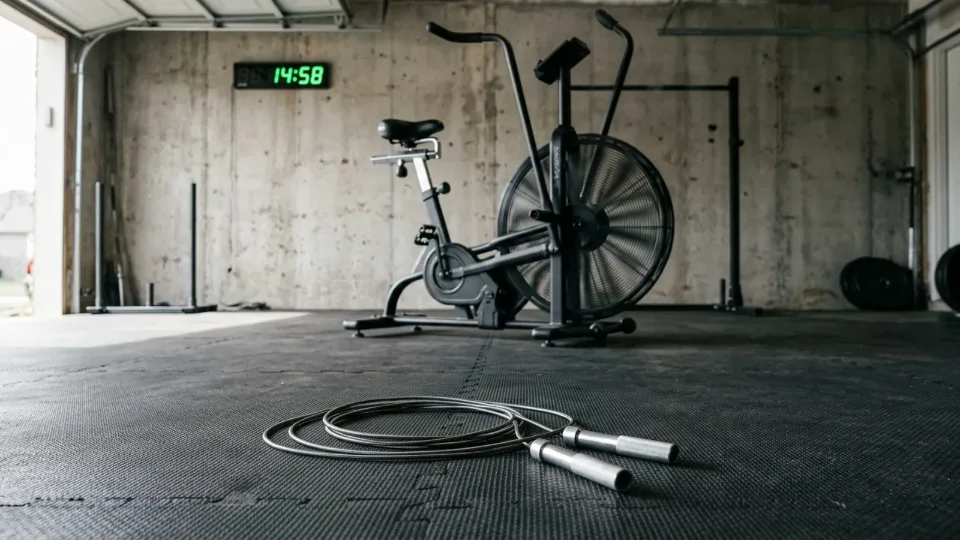
This session takes 20 minutes on the clock, uses two pieces of kit and needs about two square metres of floor beside the bike. It is built for days when time is short but you still want to finish properly out of breath. Do it once or twice a week alongside strength work, not every day.
The plan at a glance
| Clock | Block | Work:rest |
|---|---|---|
| 0:00 to 4:00 | Warm-up, bike and rope | Continuous |
| 4:00 to 10:00 | Rope intervals, 6 rounds | 30 s : 30 s (1:1) |
| 10:00 to 11:00 | Easy walk, sip of water | Rest |
| 11:00 to 17:00 | Air bike sprints, 6 rounds | 20 s : 40 s (1:2) |
| 17:00 to 20:00 | Cool-down | Continuous |
Before you start
Check the rope length: stand on the middle of the cable with one foot and the handles should reach roughly to your armpits. Too long and it slaps the floor in front of you, too short and you clip your toes. Set the bike seat so your knee is slightly bent at the bottom of the pedal stroke, as on any bike. Put a timer where you can see it from both stations, because you will not want to think about the clock later.
Warm-up, 4 minutes
- Minute 1: easy pedalling, arms moving, breathing through the nose.
- Minute 2: rope, basic two-foot bounce at an easy pace, small jumps that just clear the cable.
- Minute 3: back on the bike, with three 10-second pick-ups to a pace you would call hard but not flat out.
- Minute 4: leg swings, ankle bounces and arm circles, then walk to the rope.
Block 1: rope, 6 x 30 seconds
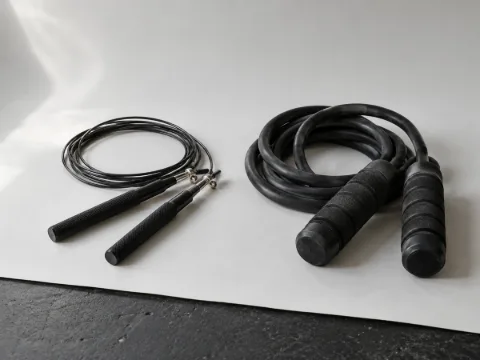
Use the Speed Rope here. Thirty seconds of quick single unders, thirty seconds of rest, six times. Aim for a rhythm you can hold for the full 30 seconds rather than a fast start followed by a string of trips. For most people, 70 to 90 turns a round is a fair target. If you have double unders, swap 5 to 10 of them into the last 10 seconds of each round.
The usual mistake on the rope is jumping too high and turning from the shoulders. Keep the elbows close to the ribs, turn with the wrists, and land on the balls of the feet with soft knees. A jump of 2 to 3 cm is plenty.
Block 2: air bike, 6 x 20 seconds
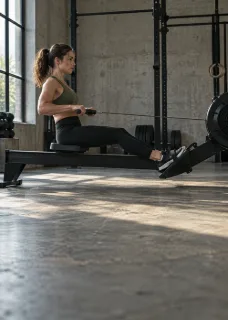
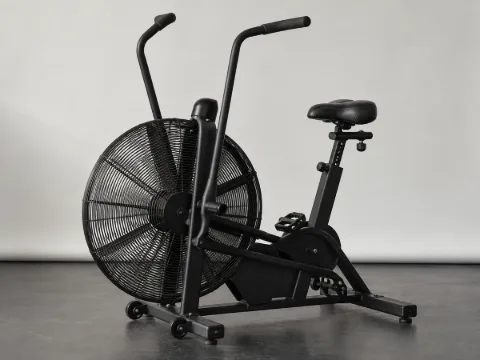
An air bike has no levels to set: the harder you push and pull, the more the fan pushes back. On the Air Bike A1 the effort is entirely yours. Sprint for 20 seconds with arms and legs together, then pedal very easily for 40 seconds. The 1:2 ratio is deliberate. Air bike sprints get hard quickly, and the longer rest lets you repeat a similar effort six times instead of fading after round three.
Here is how to judge it. Note the calories shown at the end of each sprint. Say round one reads 9 and round six reads 7. That is a drop of about 22%, which tells you the rest was a little short for you today, or you went out too hard. Next time, rest 45 seconds or hold back slightly in round one. If round six matches round one, there is room to push harder.
Cool-down, 3 minutes
Two minutes of easy pedalling with the hands resting on the handles, then a minute of slow walking with long breaths out. Your breathing should have settled noticeably by the end. Stretch calves and hip flexors afterwards if they feel tight, since they do most of the work in this session.
Scaling for beginners
- Swap in the Weighted Jump Rope. The heavier cable turns more slowly and you can feel where it is, which makes timing much easier.
- Change the rope block to 20 seconds on, 40 seconds off, and step side to side instead of jumping when your calves tire.
- On the bike, sprint for 15 seconds and rest for 45 (1:3), and keep the sprints hard rather than all-out.
- Do four rounds of each block instead of six and add the spare minutes to the cool-down.
Add rounds before you cut rest. Once six rounds at the full timings feel controlled, the next step is to trim the bike rest to 30 seconds, or to add a third block of rope work after a two-minute break.
A note on body weight
The bike takes riders up to 150 kg (331 lb), and the session scales to any body weight because the fan simply matches your output. The rope does not scale the same way, since every jump lands your full weight on the calves. Heavier lifters should start with the weighted rope, short rounds and a forgiving floor such as rubber matting rather than bare concrete.
Comments
0Leave your comment