






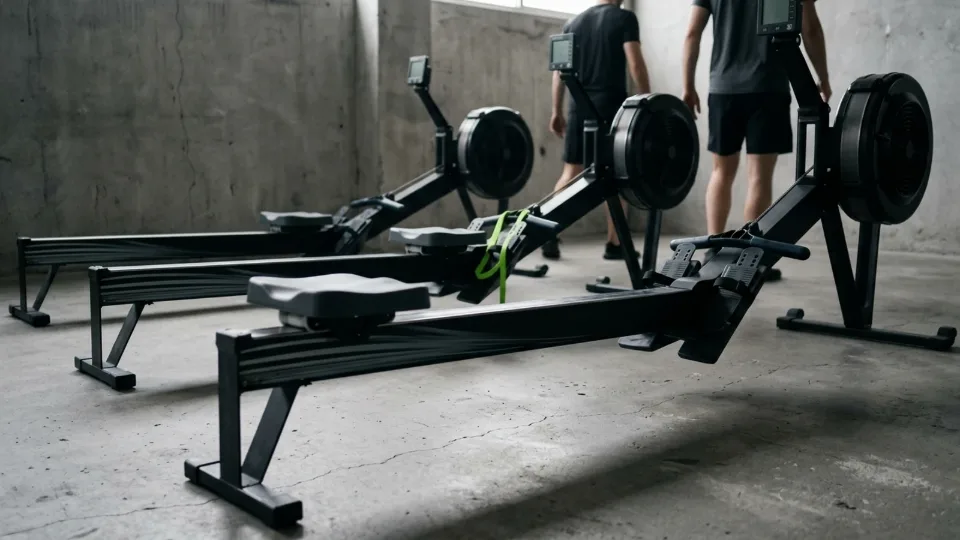
At 6.30 in the morning, in a first-floor flat, the difference between rowers stops being theory. One sounds like a fan heater, one like a sink draining, and one barely makes a sound at all. Noise is not the only factor, but it settles more of these decisions than the spec sheet does.
Where the resistance comes from
Air
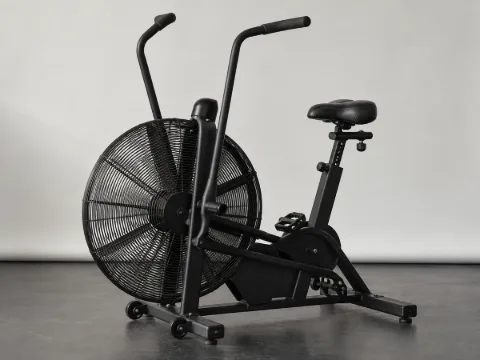
A fan spins inside a housing. Pull harder and the fan pushes more air, so the resistance rises with your effort. That makes an air rower honest: there is no level to hide behind, and a sprint feels like a sprint. The Air Rower R5 ($899) works this way, folds for storage and takes users up to 150 kg (331 lb).
Magnetic
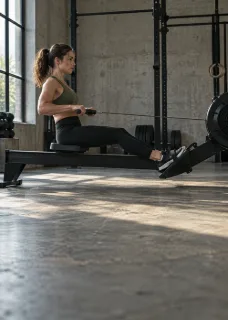
Magnets move closer to or further from a metal flywheel. You choose a level and the resistance at that level stays steady. It is the quietest of the three by a clear margin, because nothing is moving air or water. The Magnetic Rower M3 is $599 at the moment (usually $679), folds, and is rated for users up to 130 kg (287 lb).
Water
Paddles turn inside a sealed tank. Like air, resistance rises with how hard you pull, but the catch at the front of the stroke feels heavier and the finish smoother, closer to a boat. You set the overall load by how much water is in the tank, which is a once-in-a-while job, not something you change mid-session. The Water Rower W7 ($1,199) has a clear tank and a dark wood frame, takes users up to 150 kg (331 lb), and does not fold.
Damper settings and levels
The damper on an air rower is the most misunderstood control in a home gym. It opens and closes vents on the fan housing. Open, the flywheel slows down faster between strokes and each stroke feels heavier, like rowing a heavy boat. Closed, it feels lighter and quicker, like a fast racing shell.
It does not set how hard the workout is. You do that with your legs. Most people row best somewhere around 3 to 5 out of 10. Running it at 10 is the classic mistake: it loads the lower back, slows your stroke rate and usually lowers your output.
Magnetic levels do change the load directly. Start low, learn the sequence of legs, body, arms, and go up a level only when your stroke stays clean for the full session. Water has neither: fill to the marked line, row, and adjust the fill after a few weeks if the catch feels too heavy or too light.
Noise, space and storage
| Air R5 | Magnetic M3 | Water W7 | |
|---|---|---|---|
| Price | $899 | $599 | $1,199 |
| Noise | Loudest, rises with effort | Quietest | Soft rhythmic swoosh |
| Folds | Yes | Yes | No |
| Max user weight | 150 kg (331 lb) | 130 kg (287 lb) | 150 kg (331 lb) |
| Changing resistance | Effort, damper sets feel | Levels | Effort, tank fill sets load |
Full-size rowers are long, typically somewhere between 2 and 2.5 m, and you need about half a metre of clearance behind the rail for the seat and your hands at the finish. Check the footprint on each product page before you measure the room. A folding rower still needs that length while you use it; folding only helps between sessions.
Who each one suits
- Air: interval training, short hard pieces, anyone who wants their numbers to compare across sessions. Garages and ground floors.
- Magnetic: flats, early mornings, shared houses, people who prefer to set a level and settle into steady work. Good for beginners who want predictable resistance.
- Water: longer steady rows, people who care how the machine looks in a living room, and anyone who wants a smoother, boat-like stroke. Needs a permanent spot.
A worked example
Two flatmates on the first floor: one 62 kg (137 lb), training for general fitness, one 104 kg (229 lb), using the rower as a warm-up before lifting. They want 20 to 30 minutes most mornings before 7, and the rower has to go behind a sofa afterwards.
The water rower is out: it does not fold, and the sofa spot needs something that does. The air rower would work for both of them on weight, but a hard 500 m piece at that hour will be heard downstairs. The magnetic M3 is quiet, folds, and its 130 kg (287 lb) limit covers both of them with room to spare. At $599 it is also the cheapest of the three full-size machines.
If they moved to a house with a garage, the answer would probably change to air. The best rower is mostly a function of where it lives.
Comments
0Leave your comment