



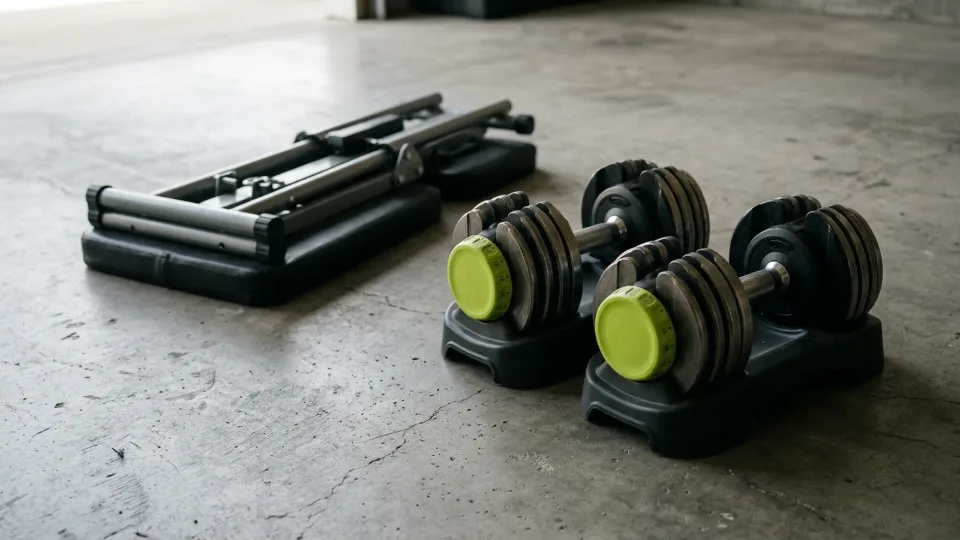
Most people buy adjustable dumbbells to save floor space, then find out the real decision is how often they change the weight. A pair you adjust twice a session is a different tool from a pair you adjust twelve times. Settle that first and the rest of the choice gets short.
The three options
Dial dumbbells
The handle sits in a cradle, you turn a dial at each end, and you lift out only the plates you selected. A change takes two or three seconds. The trade-offs: the handle is longer and bulkier than a fixed dumbbell, the mechanism does not like being dropped, and you are limited to the steps the dial offers, usually around 2 to 2.5 kg at a time. They suit people who move between rows, presses and curls in one session, or train in circuits.
Spinlock dumbbells
A threaded handle, cast iron plates and two star collars. Changing weight means unscrewing both collars, swapping plates and screwing them back on, which takes 30 to 60 seconds. They are cheap, very hard to break and easy to extend with more plates later. The costs are time, and collars that work loose mid-set if you do not snug them up.
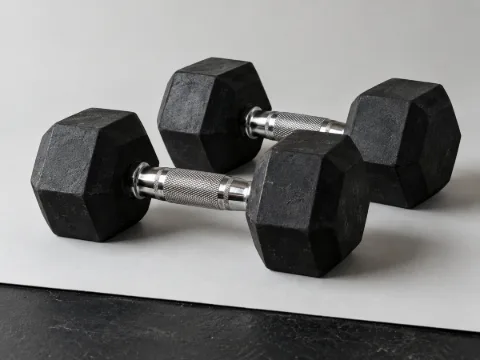
Fixed hex dumbbells
One weight per dumbbell, nothing to adjust. Fastest to use, the most durable, and the right choice for drop sets or for setting a weight down hard at the end of a set. The problem is space and money: a full run from light to heavy needs a rack and a wall to put it against.
| Type | Change time | Floor space | Drop-tolerant |
|---|---|---|---|
| Dial | 2 to 3 seconds | Two cradles | No |
| Spinlock | 30 to 60 seconds | Two handles plus a plate stack | Mostly |
| Fixed hex | None | A rack, often 1.2 m wide or more | Yes |
How heavy the top end should be
Buy for the lift you will do heaviest, not the one you do most. For most people that is a one-arm row, a goblet squat or a Romanian deadlift, and those outgrow a light set long before curls do. A rough guide:
- New to lifting, mostly presses, lunges and arm work: 16 to 20 kg (35 to 44 lb) per hand covers the first year.
- Training consistently for a year or more: 24 kg (53 lb) per hand handles rows and split squats for a long time.
- Strong lifters who want heavy rows, goblet squats and a dumbbell bench press: 32 kg (71 lb) or more.
People overestimate pressing numbers. Someone who benches 60 kg (132 lb) on a barbell will usually press somewhere around 20 to 24 kg (44 to 53 lb) per hand for sets of eight. Rows are where they run out of weight first.
Read set names carefully. The Spinlock Dumbbell Set 20 kg (44 lb) is the total across two handles, so about 10 kg per hand once fully loaded. At $69 it is a good light pair, not a substitute for a heavy one.
Space, and the bench
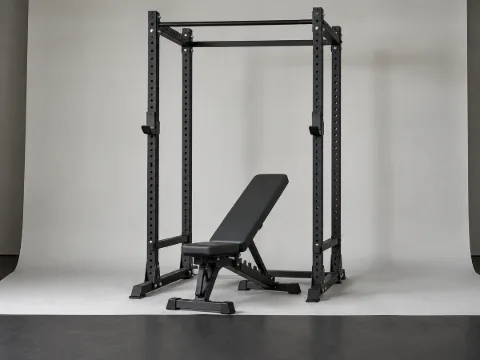
The dumbbells are the small part of the footprint. Plan a clear area of about 2 m by 2 m: a bench down the middle, room for your elbows on a fly or a press, and a step back from a lunge. If the room has to go back to being a spare room after training, a Folding Utility Bench ($149) folds away against a wall, and dial cradles slide under a bed or desk.
Mistakes we see most often
- Buying the ceiling you already lift. If you row 22 kg (49 lb) for ten today, a 24 kg (53 lb) pair gives you a few months, not years.
- Dropping dial dumbbells. Lower them to the floor or back into the cradle. A bent plate or a dial that no longer lines up is the usual failure.
- Ignoring handle length. Dial handles are longer than fixed ones. They can clip your thighs on curls and knock together at the top of a press until you adjust your grip.
- Using spinlocks for supersets. A minute of collar work between exercises turns a 30-minute session into 45.
A worked example
Priya trains three times a week in a spare bedroom, with a budget of about $500. Her sessions are goblet squats, one-arm rows, incline presses, Romanian deadlifts and lateral raises. Her best row is 20 kg (44 lb) for ten.
Option one is the Dial Adjustable Dumbbell 24 kg (53 lb) at $299 plus the folding bench at $149: $448, with 4 kg of headroom on her heaviest lift. Option two is the Dial Adjustable Dumbbell 32 kg (71 lb) at $379 plus the bench: $528, slightly over budget but with room to grow for two or three years of rows and goblet squats.
She went with the heavier pair and the bench, and skipped a second light set. Had she been doing a lot of supersets, the spinlock set left permanently loaded for lateral raises would have saved a dial change every round, for $69.
Our rule of thumb: if you cannot decide between two maximums, take the heavier one. Nobody returns a dumbbell for being too heavy a year later, and our 30-day returns window is there if the handle simply does not suit you.
Comments
0Leave your comment