
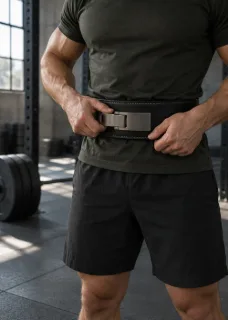
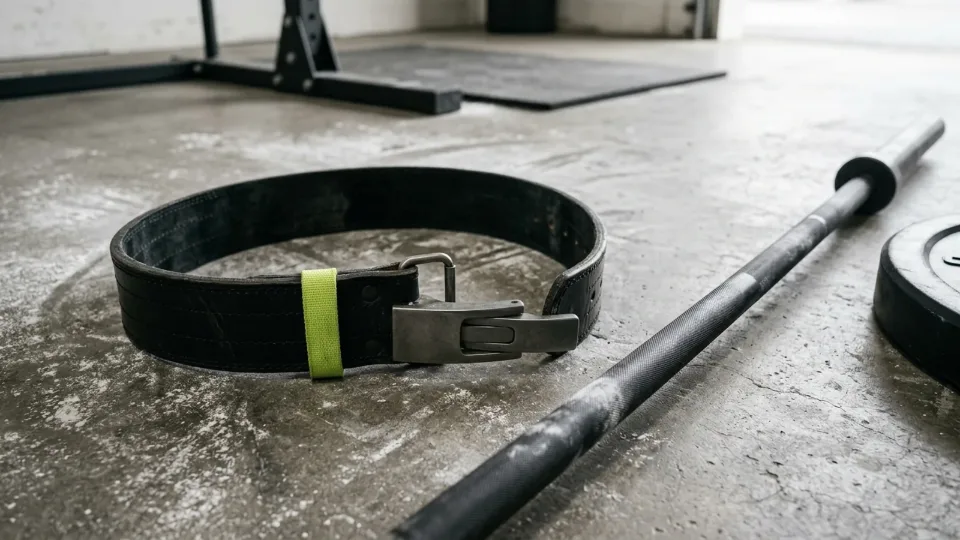
A lifting belt does one job: it gives your abdominal wall something to push against. You take a big breath into your belly, brace as if someone is about to poke you in the stomach, and the belt makes that brace firmer. It does not lift the weight for you, and it does not fix a back that rounds under load. Used that way, a belt is one of the cheapest bits of kit for heavy squats and deadlifts. Used as a back brace for every set, it becomes a crutch.
Three ways to fasten a belt
Lever
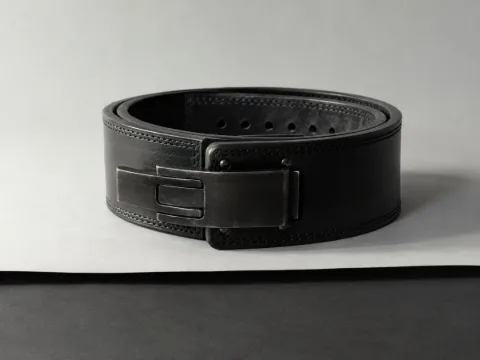
A lever buckle snaps shut in one motion and pops open just as fast, which matters between heavy sets when you want to breathe. You set the tightness once by screwing the lever into a row of holes. The catch is that changing it needs a screwdriver, so a lever belt suits one person whose waist stays fairly stable. If you squat with the belt one notch tighter than you deadlift, you will be unscrewing it more than you would like. Our 10 mm Lever Belt ($129) is the one we see most on lifters who train alone.
Prong
A single-prong belt works like a trouser belt made of thicker leather. It adjusts by the hole, takes a few seconds longer to get tight, and you may need to pull hard or lean against the rack to reach the last hole. In return you can go a notch looser for deadlifts, share it with a training partner, or wear it over a jumper in a cold garage. The 13 mm Prong Belt costs $119. Skip double-prong belts if you can: two prongs are fiddly and add nothing a single prong does not.
Nylon with hook-and-loop
Nylon belts are lighter, softer at the edges and close at any point along the strap. They do not give the same hard wall as thick leather, so they are a poor choice for a max squat. They are a good choice for Olympic lifts, kettlebell work, carries and circuits, where you move through positions a stiff belt would dig into. The Nylon Training Belt is $39 and fits in the side pocket of a gym bag.
10 mm or 13 mm
Thickness is about stiffness, not strength. A 13 mm belt is stiffer from day one and takes longer to break in, often a month of regular use before it stops pinching at the ribs. A 10 mm belt feels supportive for nearly everyone, is easier to get tight, and bends more readily for deadlifts, where you start in a folded position. Shorter lifters, and anyone with a small gap between ribs and hips, usually find 10 mm the better daily belt. Choose 13 mm if you mainly squat, already own a belt and want something firmer, or simply like a very rigid feel.
Width matters too. Most leather belts are 10 cm (about 4 in) wide; if that jams into both ribs and hips, try nylon.
Sizing it properly
- Measure around your waist at the navel, where the belt will sit, not at your jeans line.
- Measure in the clothes you train in, standing relaxed, not sucked in.
- Check that number against the size chart and aim for the middle of a size range, so you have holes either side.
- Between sizes with a lever belt, go up. You can always move the lever in, but a belt that only closes on its last setting is no use after a big lunch.
The most common mistake is ordering by trouser size. Trousers are measured lower, and on most people that number is 5 to 10 cm smaller than the navel measurement.
Wearing it
Put the belt on around the navel, then breathe into your belly and push out against it. When relaxed, you should be able to slide a flat hand between belt and stomach. When braced, you should feel firm pressure all the way round. Too tight and you cannot take a breath at all. Too loose and there is nothing to push into. Many lifters wear it slightly higher for squats and slightly lower for deadlifts, so the leather does not catch the thighs at the start of the pull.
A worked example
Say your best squat is 140 kg (309 lb). A sensible heavy day might look like this:
| Sets | Load | Belt |
|---|---|---|
| Warm-ups | 20 kg (44 lb) up to 100 kg (220 lb) | No |
| 3 x 5 | 112 kg (247 lb), about 80% | Yes |
| 2 x 8 back-off | 95 kg (209 lb) | Optional |
Putting the belt on only for the working sets keeps your unbelted bracing in practice and makes the belt feel like a tool rather than a habit.
When not to bother
- You are in your first few months of lifting and still learning to brace. Learn it without a belt first.
- The set is lighter than about 70 to 75% of your best.
- Machine work, cable rows, curls and most accessory lifts.
- Anything with a lot of twisting or deep bending, such as burpees, where the belt just gets in the way.
And if your back hurts when you lift, belt or no belt, get it looked at by a physio before you spend money on kit.
Comments
0Leave your comment